
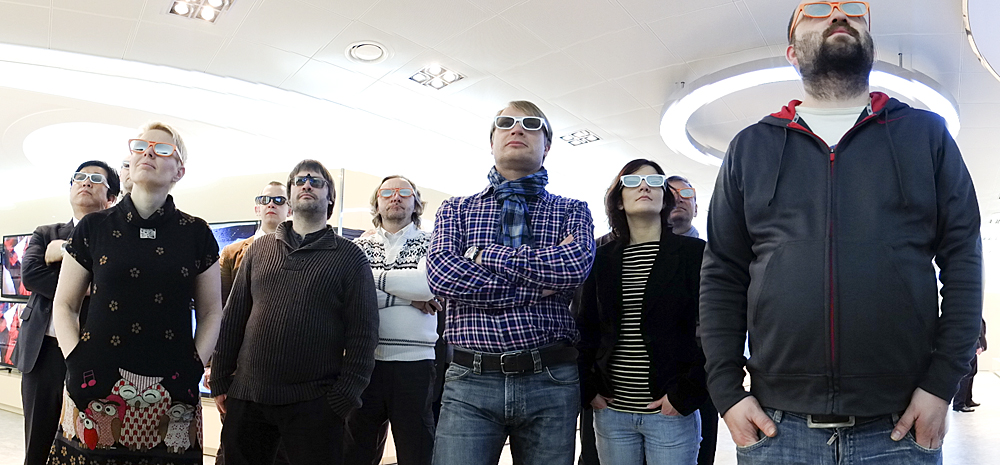
Photo: Olev Mihkelmaa
"Welcome everyone. It is nice to see a full house at the first Service Design conference here in Tallinn.
Today we’ll hear and see many presentations and case-studies that show the effectiveness of service design as principle and process. But before we get to those speeches I’ll try to define why we’re here in the first place. After all, for anyone with even a bit of service design experience will surely agree with me, that most of it looks like adults playing with post-it’s trying to look important. Service design is a buzz word. But what does it mean?
Let’s start with the word design. For most people this means making things look nice. To put it in context: many years ago, when we still used drip coffee makers in the office we had two of them. One looked really nice. One was used. The one that looked really nice, if you tried to pour coffee into your mug, you’d also cover the whole kitchen counter with caffeine creating the world’s first wired kitchen. So we used it only during important client meetings because clients knew how much this coffee maker cost. The other one was used to pour coffee into the cup when people wanted coffee. Consequently, good design was not functional. Functional design was not beautiful and this is how a majority of the population views design. Things that look nice but don’t really work. Design, however, is not really about aesthetics. It is a problem solving discipline that makes products and services easy to understand, usable, attractive and noticeable. But when things are working, nobody thinks that they’ve been designed. Swiss Army Knife.
Turning to the word service we like to think that service is something somebody else does for us. Be it a physical service, like bringing food to the table in restaurant, or a virtual service, delivering video-on-demand at the push of one button. In fact, I would hypothesize that service design comes from software and user experience design: we have all used bad websites and wondered aloud why it takes 25 clicks to get to the right information when other sites provide it on the front page. Interface designers learned how to fix things. Now this skill is being applied to the real world.
Either way, service is what most of us now buy and sell, because making things is handled either by machines, or companies in China. Because making things has become easy, how you deliver the things you make to your customers becomes a key point of differentiation. For example IKEA has long had instructions for assembling furniture that don’t include any text whatsoever. Apple makes the iPod, but it is a challenge to find people who’ve actually read the instructions for using it. Each push of the button or swipe delivers the next step’s instructions without the need to refer to a complex manual. Contrast this with the incomprehensible operating menu of a Nokia phone. It is frustrating for people not to be able to understand and for years, it was people that thought they were dumb.
And this is the point where service design comes in – the realization that as people we’re not dumb, but we just hate standing in line, waiting on the phone, or trying to program a DVD player using the remote control to type text! The big problem with services is that the people providing the “service” usually can’t see what’s wrong with it, because they know how things work. But for anyone arriving in Tallinn by ferry the first time, it can be quite disconcerting to step out of the terminal and see a sign ‘centre’ that directs the pedestrian accross 5 hectares of undeveloped wasteland littered with garbage, without a single additional sign before they actually arrive in the city centre. For the person putting the sign at the ferry terminal, it was probably difficult to understand why you need a sign in the first place. The city is over there, what’s the problem?
Once many-many years ago I had to learn Soviet signs. It was back in 1994, Estonia was truly post-Soviet and I went to the local pizza joint to get something to eat for lunch. It was summer, the door was open and a chair was placed in the doorway. Being practical, Western and hungry I stepped over the chair just to be shouted at, ‘that don’t you understand that we are closed because of a broken water pipe?’ I wonder what they place in the doorway if there’s no electricity?
A case on TED illustrated the need for good signage as part of a good service with the example of the new Terminal 5 building in Heathrow. For anyone arriving for the first time it was a challenge to find the train. The first sign you saw stepping out the gate was ‘trains to central London’. This sign was, say, yellow. After walking for about 200 feet, which in a building is quite a distance, you were confronted with the sign, now purple, ‘Heathrow Express’. This all makes sense to people who know, but a first time visitor is very confused, and stressed and quite possibly even pissed off.
However, private sector endeavours at confusing consumers pale in comparison to what the public sector can achieve. Government services are very difficult for human beings to understand. The first problem is that the language used by public services is very strenuous to comprehend. Secondly, information is not organized by how people look for it, but rather by which department and subsection is responsible for administering it. Thirdly, information entered in one database is proprietary to that department and section and is not shared to the other department that also needs it and therefore instead of making the paper run around, it is the person getting the ‘service’ that does the running.
Now, admittedly, Estonia is in by far better shape than most countries in delivering easy to use government services to the public. However, it is still department by department and often mystifying why simple things have to be so difficult. Each ministry has a different web structure, completely un-intuitive web address and confusing navigation. Contrast the simplicity of Apple products, which are guided by the principle that if you know how to use one, you can use them all while government websites require users to relearn navigation every time.
Often the reasoning behind decisions is incomprehensible and there is no way to change people’s minds. A few years ago, a colleague and I had to run a branding seminar and workshop in the middle of the country, in a very nice but quite out of the way location. To get there we obviously looked on the map and asked questions of our hosts, who assured us that there were signs on the way. Oh, and by the way, this was tourist attraction, therefore how to get there was an important issue. So off we drove and once we were getting close we started to look for signs telling us that we were going the right way. There was one! After, what seemed to be too long a distance to be quite sure - did we miss the turn-off - we saw another giving us this comfortable warm glow that we weren’t going to be late and then, again, nothing for quite a while. So we came to a fork in the road and there were signs there, but nothing that helped us. So we inched out on the road ahead and then saw the sign we were looking for pointing us right. But to see the sign we had already to have gone right so it was in a fairly pointless location. Anyway, we drove on and surprisingly enough arrived in the right place at the right time and then took the opportunity to say immediately to our hosts that, ‘guys, you need more signs. It’s very easy to get lost’ to which they responded, ‘yes, we know. But the highway department said that they won’t allow more roadsigns, because there shouldn’t be more than 2-3 per destination in this area.’ Period. There was probably a rulebook that said, ‘signs is what people expect us to put out there...’
I would argue that the problem that service design solves is, that people hate not understanding. We hate not knowing why things are as they are and what will happen next. Lack of information when we want it is very frustrating and off-putting and, given the chance, we’ll turn our back on what we don’t like. In a first aid course that I took in Canada, there were many rules and procedures for saving people’s lives. But after making sure that the person will survive the main rule was, ‘treat the patient, not the disease’. That means that you have to talk to the patient, tell him what you are doing and why. As anybody with children will appreciate, having a doctor that talks to the child in a way that is understandable to the kid makes the treatment easy and quick. But when the pediatrician is full of himself, and talks medical to make everyone feel stupid as well as telling the parent to ‘hold that kid down, or I can’t do my job’ is no way of improving someone’s health. And being powerless in situations like this really pisses people off. We don’t understand what’s going on and why, and we can’t influence the situation.
Now when you’re at the doctor’s you’re probably not going to get up and leave, just because the doctor’s a bit of prick. But if it is something you are paying for, then this just won’t do. A restaurant will never see this customer again, and that car dealership with the snotty salesmen selling zeir exklusiv automarke won’t sell very many of them. But these are all individual services of the person-to-person variety.
What happens when you have to serve thousands or millions of customers and there is a need to standardize? Financial services try to segment customers and invariably end up putting everyone in the wrong box because they don’t have data on the motivation for economic behaviour – they just see the results of behaviour. Or telco’s treating almost everyone like computer illiterates instead of helping people to become literate. McDonald’s did service design 50 years before the term was coined, and is still one of the best companies in delivering a consistent brand experience. We know what to do, why and how. I mean, their business can be described as ‘pay up front, carry your own food, eat with your hands and clean up after yourself.’ Not exactly the classical restaurant experience everyone is looking for but we like it, because we understand how it works.
Signs. Predictable behaviour. Clear instructions. Understandable rules. Whether it is government providing critical services or the hairdresser that will be back in 15 minutes, we want to understand. Service design, in my opinion, is providing the means to customers and citizens of understanding how and why things are the way they are.
And this is the challenge for companies and organizations and governments. We are used to keeping things mystical, because explaining everything properly takes a lot of time and effort. Because that also means we have to simplify and this need often involves the whole company and we can’t really do that now, because companies are built in departments where inter-departmental projects are too complicated to bother with. And for some, helping people to help themselves is a sure fire way of eventually getting fired, so there may be some disinterest there. In the long run, however, I think the efficiency gains that companies are looking for and the financial savings that governments desperately need makes a clear case for creating services and providing the information that allows people to help themselves as much as possible. And more informed, motivated customers are better customers, because they actually want to buy what you are offering instead of ‘just looking’, because they aren’t sure of what you are selling. Service design, as a tool pays for itself by simply making things more efficient, aligning customer needs with company motivation, and providing the information background necessary to make right decisions.
Service design is the future. But it was the future already thousands of years ago when someone in China said, “Tell me and I will forget. Show me and I may remember. Involve me and will understand.”







 Posts
Posts

